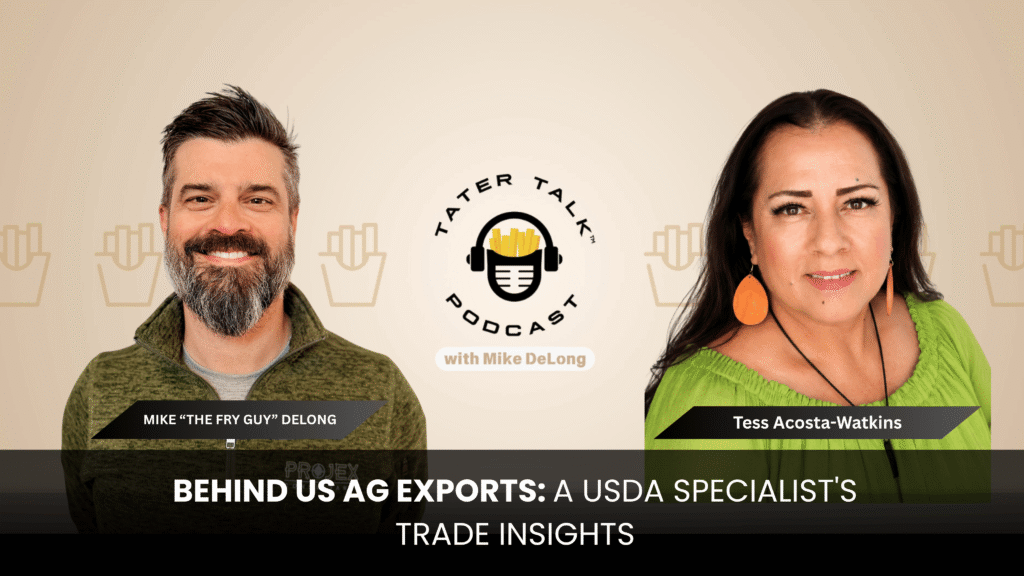
Welcome back to the Tater Talk Podcast! Today, we’re peeling back the layers of global agriculture with a truly remarkable guest, Tess Acosta-Watkins. With an impressive 34-year career at the USDA, including two decades as a trade specialist supporting U.S. agricultural exports, Tess brings a wealth of knowledge and experience. Since her retirement, she’s founded TradeUp Global Agri Trade Consulting, where she now assists growers, packers, exporters, and industry groups in navigating the complexities of global trade. Join us as Tess shares her fascinating journey and invaluable insights into the world of potato exports and beyond.
From Microbiology to Global Trade: A Career in Agricultural Protection
Tess Acosta-Watkins’ journey into agriculture was anything but conventional. Hailing from New Mexico and a proud alumna of New Mexico State University, she initially pursued microbiology and economics, with a fleeting thought of pharmacy. Her path took an unexpected turn at a college job fair, leading her to an offer from the USDA’s Animal and Plant Health Inspection Service (APHIS), Plant Protection and Quarantine (PPQ).
Her career began as a plant protection and quarantine officer at LAX, where she fell in love with the international arena, clearing cargo, flights, and passenger baggage. This role provided a unique window into global trade, exposing her to people and products from all corners of the world. Tess’s early career saw her move to Miami, a hub for cut flower imports from South America, and then to the U.S.-Mexico border in El Paso, dealing with Mexican cargo and passengers.
A significant shift occurred in 2002 when Tess became the port director at Phoenix Sky Harbor International for the USDA APHIS PPQ AG Clearance Department. This was right after 9/11, a pivotal moment that led to the creation of the Department of Homeland Security (DHS). Tess, along with her colleagues, transferred into DHS, becoming part of Customs and Border Protection (CBP). As she proudly states, she’s a “founding member” of the DHS, having played a role in the technical and administrative integration of these agencies.
Transition to Trade Specialist and the World of Potatoes
After several years with CBP, Tess seized an opportunity to return to the USDA as a trade specialist. This new role allowed her to oversee export work across eight to ten states, including Hawaii and Guam. It was in this capacity that she first became deeply involved with the potato industry, particularly in Colorado, a major potato-producing state.
Tess’s tenure as a trade specialist coincided with a critical period for U.S. potato exports to Mexico. For many years, Mexico restricted the entry of U.S. potatoes to within 26 kilometers of the border. This limitation, in place for approximately 25 years, significantly constrained market access. The landscape dramatically changed in 2022 when Mexico finally opened its interior market to U.S. potatoes, marking a “big jump into greater market access.”
U.S. Potato Exports: Key Markets and Trends
While Tess doesn’t have specific historical volume data for the pre-2022 Mexican market, she highlights the current state of U.S. potato exports. Overall, U.S. agricultural exports stand at approximately 41 billion tons, or 19 million metric tons. Canada and Mexico are the two largest trading partners for U.S. potato exports, with roughly equal volumes but distinct product types.
- Mexico: Primarily imports U.S. table stock and potatoes for processing. This accounts for about 1.9 billion in value.
- Canada: Also a significant importer, at around 1.7 billion in value. However, a large portion of these potatoes are destined for frozen processing, particularly for French fries. The U.S. often supplies Canada during their off-season, particularly in spring and summer, before Canada’s fall harvest meets their domestic demand.
The Mandate of a USDA Trade Specialist
As a trade specialist with the USDA APHIS PPQ, Tess’s mandate was rooted in the agency’s role as the National Plant Protection Organization (NPPO) for the United States. Every country that is a member of the World Trade Organization (WTO) and adheres to the International Plant Protection Convention (IPPC) has its own NPPO. These organizations are responsible for protecting their nation’s agriculture from pests and diseases, and for facilitating safe international trade.
Tess’s work involved ensuring that U.S. agricultural products met the phytosanitary requirements of importing countries. This often meant collaborating closely with industry groups like Potatoes USA and the National Potato Council. These organizations represent the interests of potato growers and exporters, advocating for market access and working with the USDA to address trade barriers. The USDA, as the regulatory body, provides the scientific and technical expertise to develop export protocols and negotiate with foreign governments, ensuring that U.S. potatoes can be safely and legally exported worldwide.
Tess Acosta-Watkins’ extensive career offers a unique perspective on the intricate world of agricultural trade, from protecting borders to opening new markets. Her insights underscore the vital role of the USDA and the dedication of specialists in ensuring the global reach of U.S. agriculture, including our beloved potatoes. To dive deeper into Tess’s experiences and gain more invaluable perspectives on agricultural exports, be sure to listen to the full episode of the Tater Talk Podcast with Mike DeLong!
Important Links
About Tess Acosta-Watkins
Tess Acosta-Watkins is the Founder and Principal Consultant of TradeUP Global AgriTrade Consulting, LLC. She recently retired from USDA APHIS Plant Protection and Quarantine after 34 years of federal service, including 20 years as a Trade Specialist supporting export certification, market access, and agricultural trade compliance programs. She is also a proud alumna of New Mexico State University. Her experience includes working with U.S. potato export programs, Mexico market access requirements, facility registration, compliance readiness, and broader plant health trade issues. Through TradeUP, Tess now supports growers, packers, exporters, and industry groups by helping them better understand export requirements, prepare for regulated markets, and stay ready for opportunities in global agricultural trade.