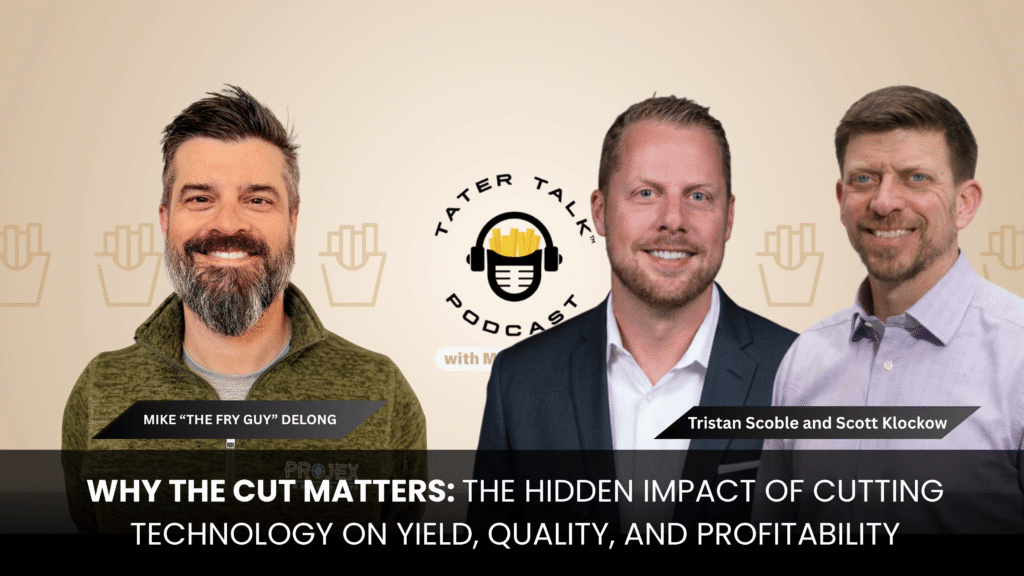
Welcome to another insightful episode of the Tater Talk Podcast! Today, we dive deep into the world of food cutting technology with two esteemed guests from Urschel Labs: Tristan Scoble, Director of Sales for North America and Mexico, and Scott Klockow, Director of New Product Development and Applications. Urschel is a name synonymous with precision and innovation in the food industry, often considered the global leader in food cutting solutions. Join us as Tristan and Scott share their expertise and shed light on how cutting technology profoundly impacts yield, quality, and profitability in potato processing and beyond.
Meet the Experts: Tristan Scoble & Scott Klockow
Our episode kicks off by getting to know our guests. Tristan Scoble, with Urschel since 2016, started his journey in the Midwest Territory before moving to Southern California, gaining extensive on-the-ground sales experience. A year ago, he transitioned into his current role as Director of Sales, overseeing North America and Mexico. Tristan speaks highly of Urschel, calling it a “very rare beast for its age” – a company that has thrived for 116 years.
Scott Klockow brings two decades of experience to Urschel, having grown up within the engineering side of the organization. For his first ten years, Scott designed food processing machines, including dicers for the meat and cheese markets. He then became the manager of the design engineering team, where he began delving into the potato industry. Last year, Scott took on the role of Director of New Product Development and Applications, acting as the crucial liaison between engineering and sales, ensuring complex applications are met with the best solutions.
Urschel’s Storied History: From Gooseberry Snippers to Global Leadership
Tristan delves into Urschel’s fascinating history, a company founded in 1910 by William Urschel. Its origins trace back to the invention of the Gooseberry Snipper, a device designed to destem gooseberries – a quaint beginning for a company that would become a global powerhouse. From these humble roots, Urschel has always been driven by strong engineering principles, based in Valparaiso, Indiana, about an hour from Chicago.
Over the years, Urschel naturally progressed into the broader world of food size reduction. Today, its machinery branches into several key areas:
- Dicers & Slicers: Dominating the potato industry for fry cutting and crinkle cuts.
- Comitrol Line: Specializing in creating nut butters and other fine comminuted products.
What truly sets Urschel apart, as Tristan explains, is its vertical integration. Almost everything, apart from electrical components, is manufactured in-house, including two on-site foundries. This allows Urschel to control every aspect of production, “from the metal that comes in to the machine that leaves the door,” ensuring unparalleled quality and consistency.
The ESOP Transition: A Catalyst for Growth and Pride
Mike inquires about Urschel’s transition to an Employee Stock Ownership Plan (ESOP), a relatively recent development announced in February 2016. Tristan, who initially thought the company was being sold, quickly realized the immense benefits of this move.
While Urschel has traditionally been a slow-growth company, the ESOP has played a significant role in managing accelerated growth, especially over the last 15 years. This acceleration is largely driven by manufacturers’ increasing need for efficiencies, which Urschel’s equipment often provides by eliminating manual cutting processes. The ESOP has fostered a strong sense of ownership and pride among employees, helping the company stay cohesive even as its workforce grew from 350 to 580 people.
Scott echoes this sentiment, recalling a time when, as a younger engineer, he felt a personal responsibility to ensure his designs reflected the Urschel name well. Now, with shared ownership, every employee shares that same desire to uphold the brand’s strength, quality, and reliability. This collective commitment ensures that Urschel continues to “hit on all cylinders each time,” maintaining its reputation for excellence.
The conversation with Tristan Scoble and Scott Klockow provided a fascinating glimpse into Urschel’s rich history, its innovative approach to food cutting technology, and the unique culture fostered by its employee ownership. Their insights underscore how a company’s past, its engineering roots, and its commitment to its people can converge to create a global leader in an essential industry. To hear more about Urschel’s cutting-edge solutions and their impact on the potato industry, be sure to listen to the full episode of the Tater Talk Podcast!
Important Links
- Tristan Scoble’s LinkedIn
- Scott Klockow’s LinkedIn
- Urschel Laboratories Website
- Urschel Laboratories LinkedIn
About Tristan Scoble & Scott Klockow
Tristan Scoble is a veteran sales leader in the industrial food processing sector, currently serving as the Director of Sales at Urschel, the global leader in precision food cutting technology. With over a decade of experience at Urschel, Tristan has navigated the complexities of both Midwest and Western U.S. markets, transitioning from Regional Sales Management to a global strategic leadership role. His background is unique, blending technical expertise in Multimedia Computing with a high-performance sales career that began in insurance and fire protection. He is known for a “self-starter” mentality and a reputation for crushing quotas and building deep-seated industry relationships.
Scott Klockow is a seasoned engineering leader with over 25 years of experience in mechanical design and product development. Currently the Director of Applications and Product Development at Urschel, he oversees the innovation of industrial food cutting technology. Scott’s career is defined by a deep technical foundation, including a Master of Science in Mechanical Engineering from Purdue University and a nearly 19-year tenure at Urschel Laboratories progressing from Design Engineer to management. His early career included six years at Ford Motor Company, bringing automotive-grade precision to the food processing industry.