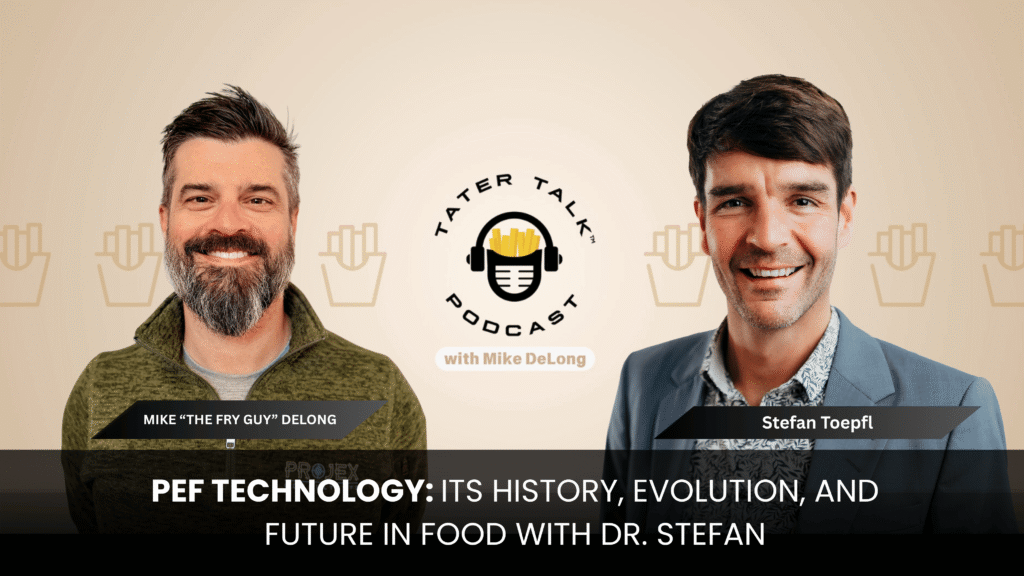
Welcome back to the Tater Talk Podcast! Today, we’re diving deep into a fascinating technology that has truly revolutionized modern food processing, especially within the potato industry: Pulsed Electric Fields (PEF). Joining host Mike DeLong is Dr. Stefan Toepfl, the managing director of ELEA, a leading PEF system manufacturer and technology developer, as well as a distinguished professor of food process engineering. Dr. Toepfl brings a wealth of knowledge and a unique perspective, having been at the forefront of PEF’s development from its academic origins to its current status as an industry standard. Get ready to explore the history, evolution, and future of this incredible innovation.
Dr. Toepfl’s Pioneering Path to PEF
Dr. Stefan Toepfl’s journey into the world of PEF technology began with his studies in food technology at a technical university in Berlin. This institution was a hub for non-thermal technology development, exploring innovations like high-pressure processing, ultrasound, ohmic heating, and, of course, pulsed electric fields. Dr. Toepfl chose to focus his diploma thesis on PEF, initially applying it to the processing of apples and vegetables. This initial dive led him to pursue a PhD, which centered on the intricate design of industrial-scale PEF equipment. As he puts it, he simply “got stuck with the topic,” captivated by its potential and the challenges of bringing it to life.
From Lab Curiosity to Commercial Game-Changer
While PEF technology might seem like a recent innovation, Dr. Toepfl reveals that the first attempts at commercial-scale PEF date back to the 1980s. Early pioneers in Germany, Ukraine, and other regions explored its potential, but they lacked the sophisticated switching technology necessary to make it viable. Initial ideas revolved around improving the separation of fish meal and meat byproducts, and later, enhancing juice extraction from apples and carrots. It wasn’t until the 1990s that the potato industry entered the picture, first exploring PEF for starch extraction.
It was during this period that a pivotal discovery was made: PEF had a “softening effect” on potato tissue. Initially seen as a disruptive element in some applications, this effect soon proved to be incredibly beneficial, even a “game-changer,” for the french fry industry. Dr. Toepfl and his colleagues played a crucial role in transforming PEF from a lab-scale curiosity into an industrial reality, developing the robust, efficient systems we see today. What was once an emerging technology is now a standard processing platform, with the focus shifting from “does it work?” to “how do we make it work optimally?”
The Genesis and Growth of ELEA
Dr. Toepfl’s deep involvement culminated in the founding of ELEA in 2012. Before ELEA’s inception, he spent years developing commercial-scale prototypes at the German Institute of Food Technologies, a not-for-profit research entity supported by numerous potato processors and other food producers. These early systems, while effective, were a far cry from the sophisticated, modern equipment ELEA produces today. By 2012, the step was taken to move from pilot scale to full industrial application, and ELEA was born, with Dr. Toepfl as a founding member and key developer.
While the belief in PEF’s potential was always strong, the true commercial value became undeniable around 2010-2011, prompting significant investment in its further development. Initially, the primary perceived benefit was simply replacing traditional preheaters for cutting. However, over time, a much broader spectrum of advantages emerged, including improvements in oil uptake, enhanced product quality management, and positive impacts across the entire production line. This continuous learning process underscores that even with established technologies, new benefits and optimizations are always being discovered, especially in applications like potato chips, where PEF is still in earlier stages of adoption compared to french fries.
Understanding Pulsed Electric Fields (PEF) in Action
For those unfamiliar with the mechanics, Dr. Toepfl provided a clear explanation of how PEF works. Pulsed Electric Fields involve applying high-voltage pulses to food materials, specifically potatoes in this context. These pulses, requiring a sufficient electric field strength (around one kilowatt per centimeter), induce a purely physical electrical effect known as electroporation. This process creates microscopic pores in the cell membranes of the potato tissue, essentially turning the potato into a structure akin to a “sponge.”
The immediate and most impactful result for the potato industry is a significant reduction in turgor pressure within the cells. Since water-filled cells are hard, reducing this pressure leads to a softer cellular structure, which is highly desirable for processes like cutting french fries. A secondary, yet equally important, effect is the easier release of water and sugars from the now-porous cells. This has profound implications for drying processes and overall product quality. In essence, PEF serves as a versatile platform technology for controlled cell disruption and opening across various food applications.
PEF’s Transformative Impact on French Fries
The success of PEF in the french fry sector is undeniable. With over 300 ELEA systems now operating globally, PEF has become an integral part of nearly every major french fry processing line. While Dr. Toepfl refrained from naming specific companies, the widespread adoption speaks volumes about the technology’s efficacy. The benefits extend far beyond mere softening for easier cutting; processors are realizing advantages in areas such as reduced oil uptake during frying, improved texture, and enhanced overall product quality consistency. As Mike DeLong noted, there’s still ongoing work to fully adapt downstream processes to truly leverage all the benefits PEF treatment offers, indicating a bright future for further optimization and innovation within the industry.
Dr. Stefan Toepfl’s insights paint a vivid picture of PEF’s journey from a scientific concept to a cornerstone of modern food processing. His dedication, along with ELEA’s pioneering work, has not only transformed the potato industry but continues to push the boundaries of what’s possible in food manufacturing. To hear more about the exciting future of PEF and Dr. Toepfl’s experiences, be sure to listen to the full episode of the Tater Talk Podcast with Mike DeLong!
Important Links
About Stefan Toepfl
Prof. Dr.-Ing. Stefan Toepfl is Managing Director of Elea Technology GmbH and Professor of Food Process Engineering at Osnabrück University of Applied Sciences. For more than 20 years, he has been working on Pulsed Electric Field (PEF) technology and its industrial application in food processing. His work has helped bring PEF from research laboratories to commercial production lines worldwide. Today, he focuses on innovative process solutions that improve product quality, sustainability, efficiency, and food safety while enabling new product concepts and manufacturing approaches.